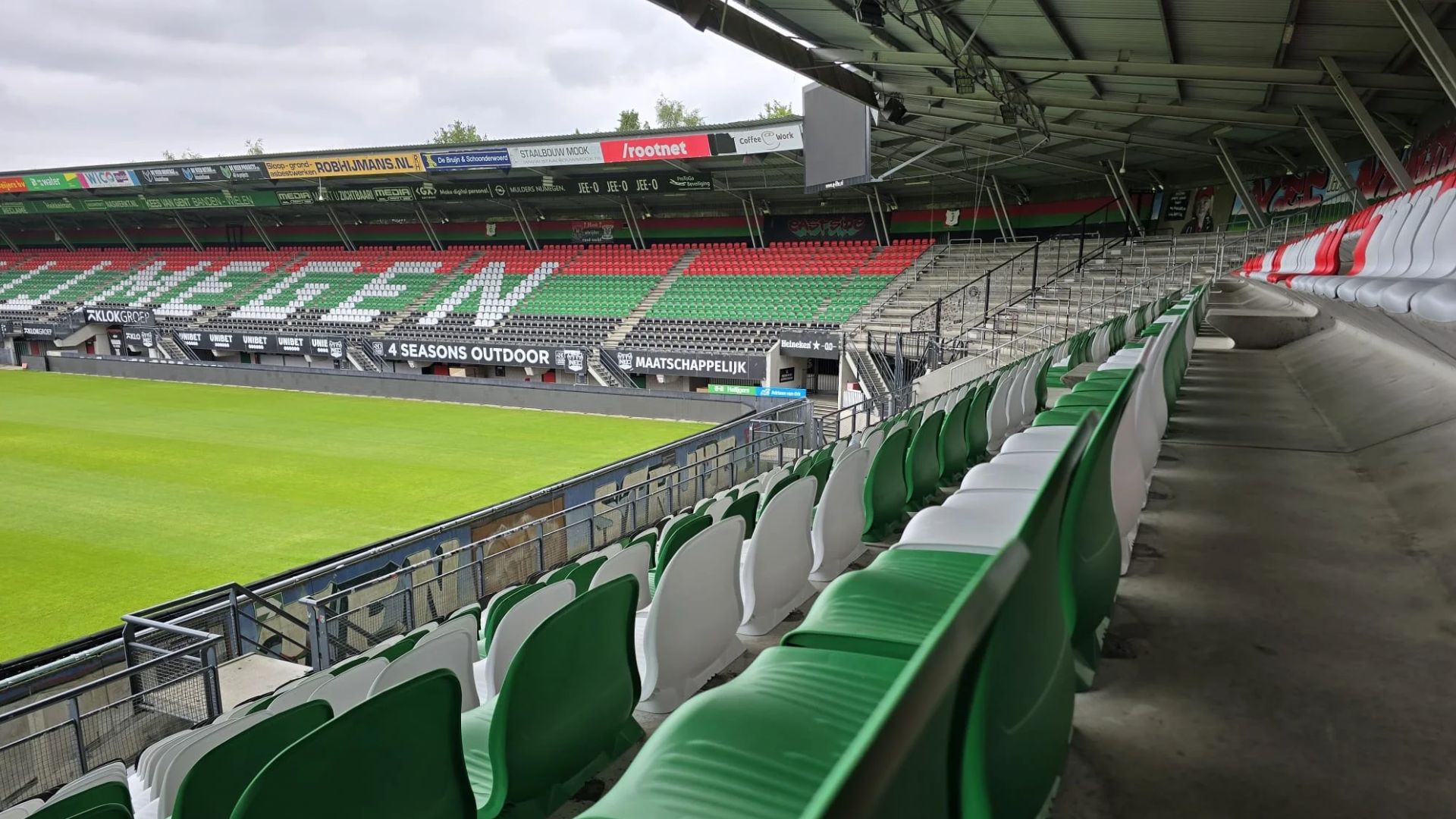
In many construction or renovation projects for sports facilities, stadium seating is defined using only two pieces of information: quantity and colour.
The problem is that this description is not sufficient to compare solutions using proper technical criteria.
Two models may look similar in a photograph while offering very different levels of resistance, maintenance, safety, durability or installation cost. For this reason, a well-written specification should go beyond appearance and establish minimum requirements that allow all bids to be assessed under comparable conditions.
At FANBASE, we design, manufacture and install sports seating from our facilities in Castalla, controlling the different stages of each project: design, mould development, prototyping, production and installation solutions.
Below, we examine six aspects that should be clearly defined in any specification for seating intended for stadiums, sports halls, leisure centres or sports venues.
1. Reference standards and accredited testing
The specification should expressly state which standards the seat must comply with and which documents the manufacturer must provide.
The main technical references for seating in sports facilities include:
- UNE-EN 12727, relating to the strength, durability and safety of seating for public use.
- UNE-EN 13200-4, specifically covering seating for spectator facilities.
A commercial declaration of compliance should not be considered sufficient.
It is advisable to require test reports issued by accredited laboratories or technology institutes, clearly identifying the tested model and the results obtained.
The FANBASE SPARK range, for example, has been tested and certified by the Instituto de Biomecánica de Valencia in accordance with UNE-EN 12727:2017 and UNE-EN 13200-4:2008.
Recommended wording for the specification
The manufacturer shall provide technical documentation demonstrating compliance with UNE-EN 12727 and UNE-EN 13200-4 through tests carried out on the proposed model by an accredited body.
2. Resistance to sunlight and ageing
In an outdoor grandstand, seats are exposed for years to sunlight, temperature changes, moisture and adverse weather conditions.
It is therefore not enough to state that the product is “UV resistant”.
The specification should require verifiable information regarding:
- The type of material used.
- UV stabilisation.
- Light-resistance testing.
- Performance under accelerated ageing.
- Stability of colour and mechanical properties.
FANBASE seats are manufactured by injection moulding stabilised polypropylene copolymer and may include anti-UV additives to improve their performance in outdoor installations.
Recommended wording for the specification
The material shall be stabilised against ultraviolet radiation. The bidder shall provide technical documentation or ageing tests demonstrating the seat’s resistance and colour stability in outdoor installations.
3. Fire performance
Fire reaction requirements should be assessed particularly in the following situations:
- Covered sports halls.
- Auditoriums.
- Indoor grandstands.
- Installations with metal structures.
- Venues with specific evacuation requirements.
- Spaces with a high concentration of spectators.
Not every installation requires the same classification, so the project designer should define it according to the use, location and construction characteristics of the venue.
FANBASE offers fire-resistant solutions, including M2 classification options depending on the model and the requirements of the project.
Recommended wording for the specification
The seats shall comply with the fire reaction classification applicable to the venue. The manufacturer shall provide the corresponding test certificate, specifying the material, model and classification achieved.
4. Fixing system adapted to the supporting structure
One of the most common mistakes is to define the seat without specifying how it will be installed.
However, the fixing system varies depending on the supporting surface:
- Concrete grandstand.
- Riser.
- Metal structure.
- Telescopic grandstand.
- Metal bench structure.
- Existing surface requiring renovation.
- Installation on the floor, tread or front face of the grandstand.
This decision has a direct impact on:
- Installation safety.
- Number and type of fixings.
- Drilling requirements.
- Metal supports.
- Labour.
- Installation time.
- Final budget.
FANBASE offers direct installation and different support solutions, including floor-mounted, riser-mounted, metal bench and custom support systems developed according to project requirements.
Recommended wording for the specification
The bid shall include the complete installation system, specifying the type of support, fixing points, anchors, treatment of metal components and compatibility with the existing supporting structure.
5. Future availability of replacement parts
The life of a sports facility does not end on its opening day.
During its useful life, some seats will need to be replaced due to vandalism, impact damage, partial renovations, numbering changes or capacity extensions.
The specification should therefore consider:
- A commitment to the availability of replacement parts.
- Continued availability of the mould.
- Compatibility with future installations.
- The ability to reproduce colours.
- Availability of numbering, logos and accessories.
- Identification and traceability of the supplied model.
Choosing solely on price may create a problem several years later if the manufacturer discontinues the model or can no longer guarantee compatible parts.
Recommended wording for the specification
The contractor shall commit to maintaining the availability of replacement parts for the proposed model for a defined minimum period, guaranteeing dimensional and functional compatibility with the original installation.
6. Manufacturing origin and material traceability
Traceability should no longer be treated as a secondary criterion.
Knowing where the product is manufactured and what material is used makes it possible to assess:
- Quality control.
- Production consistency.
- Origin of the raw material.
- Actual response capacity.
- Availability of replacement units.
- Logistical footprint.
- Sustainability.
- Compliance with contractual commitments.
FANBASE centralises design and manufacturing in its own facilities in Castalla, where the company controls injection moulding, product development, production and quality processes. FANBASE works with seats manufactured from recyclable polypropylene copolymer and develops products designed to minimise maintenance and facilitate cleaning.
Recommended wording for the specification
The bidder shall state the place of manufacture, product origin, material composition, recyclability and the system used to guarantee traceability for each supplied batch.
A good specification reduces risk, not just price
Defining the seat correctly allows bids to be compared using common technical criteria.
It also helps prevent:
- Uncertified solutions.
- Unanticipated installation costs.
- Compatibility problems with the grandstand.
- Premature colour fading.
- Lack of replacement parts.
- Higher cleaning and maintenance costs.
- Technical non-compliance that is difficult to correct after the contract has been awarded.
A stadium seat is not simply a plastic component.
It forms part of a system that must withstand years of intensive use by thousands of spectators, weather exposure, cleaning, maintenance and safety requirements.
Technical documentation for grandstand projects
The FANBASE SPARK range includes models adapted to different sports facility requirements, with direct fixing solutions, various anchoring configurations, customisation, numbering and support options.
If you are preparing a project, technical report or tender specification, you can request:
- The SPARK CR technical data sheet.
- Available certificates and test reports.
- Drawings and dimensions.
- Anchoring options.
- Colours and customisation options.
- A BIM file for integration into the project.
Contact us and we will send you the documentation required to assess its integration into your facility.