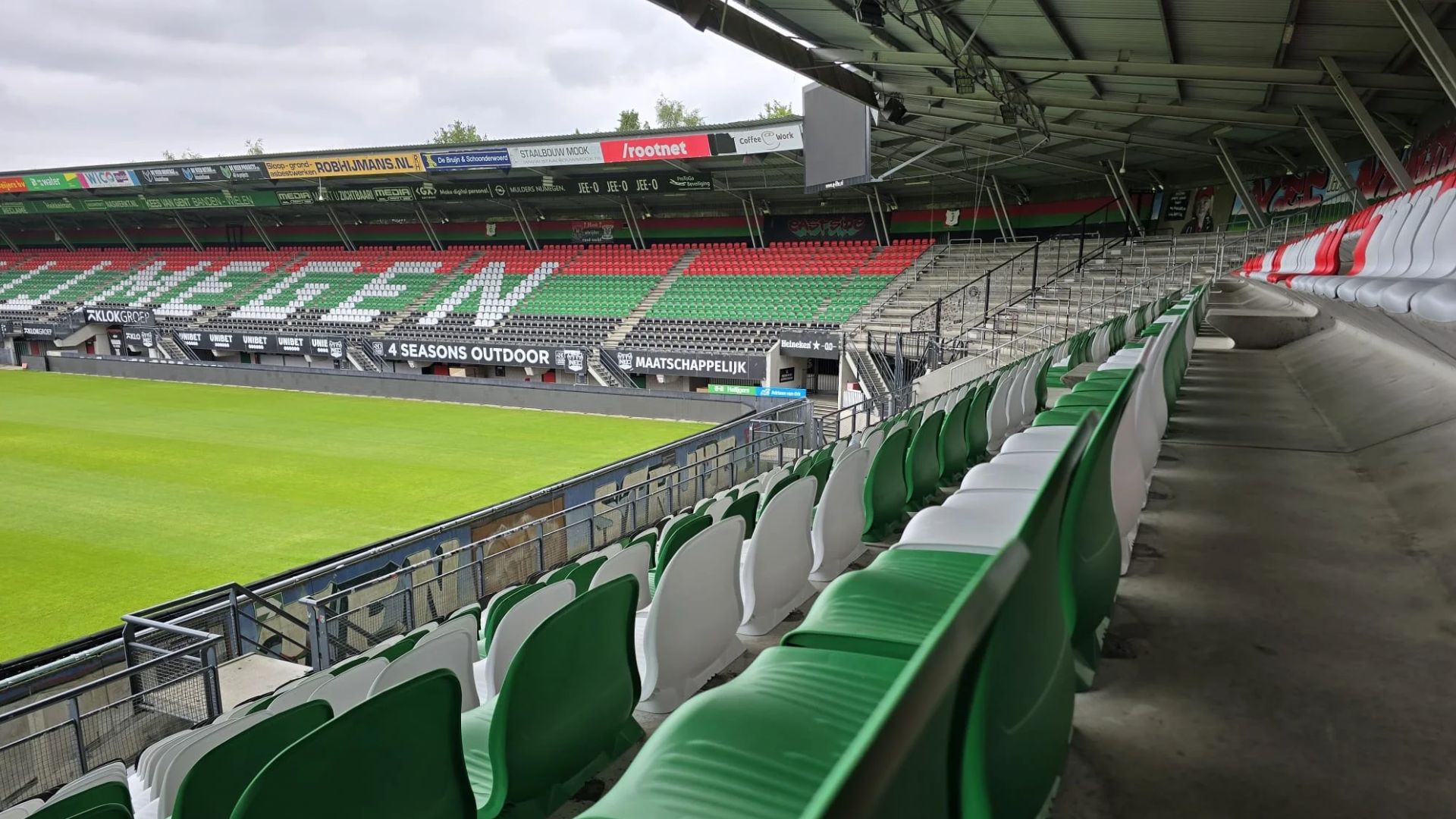
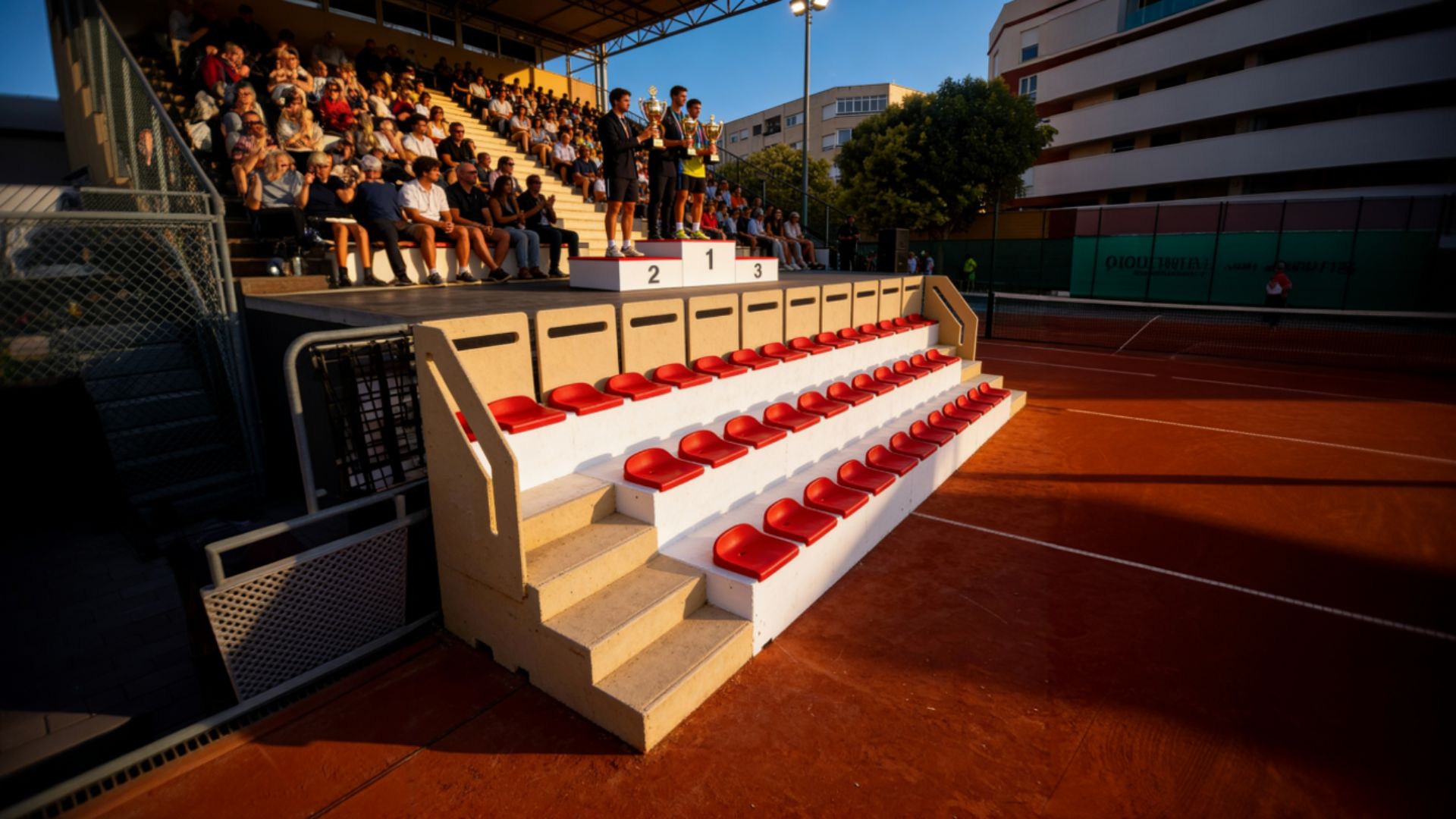
There’s a moment that repeats at almost every sports event: the big day arrives and your “normal” capacity isn’t enough. People end up standing, areas not designed for spectators get improvised, and the experience suffers right when it matters most: a tournament, inauguration, key match, fan zone or brand activation.
And the dilemma appears: How do you add seats without getting into construction, without impossible timelines, and without buying a permanent stand “just in case”?
Self-supporting modular stands for events: how to increase capacity without construction (and without guessing) with EcoBench
When the schedule calls the shots, “no construction work” stops being an option and becomes a necessity
In the real world, construction runs late. Or it comes with a level of complexity (permits, timelines, coordination) that only makes sense if you are 100% sure you’ll be filling that stand for years.
EcoBench is especially suitable when:
- You run recurring events (tournaments, leagues, camps) with peak attendance
- Your venue is multi-purpose (sports today, event tomorrow)
- The club is in a growth phase and wants to expand capacity in stages
- You need a solution for this year / this season, not “someday”
Self-supporting and modular: what you’re really buying is operational control
A self-supporting, modular stand changes the conversation with operations and event teams. You’re no longer buying “a product”: you’re buying the ability to manage spectators with order and flexibility.
With EcoBench you can:
- Create sections (families, academy, guests, sponsors)
- Adapt to the real layout (not the ideal one)
- Scale up or down depending on the event
- Approach it in phases: Phase 1 now, Phase 2 when demand repeats
It’s the difference between “I’m taking a gamble on a fixed investment” and “I’m growing with data.”
But… if it’s plastic, will it hold up?
This concern is normal because “plastic” is often associated with consumer products. But in sports facilities we’re not talking about generic plastic: we’re talking about technical plastics formulated for outdoor conditions and intensive use.
To answer with solid arguments, focus on four ideas:
1) It’s not “plastic”: it’s technical material stabilized for outdoor use
Event durability doesn’t depend on “plastic vs. metal.” It depends on what the material is, how it’s formulated, and whether it’s prepared for sun exposure and continuous use.
Serious sports solutions use technical thermoplastics (for example, copolymer polypropylene) with UV stabilization to prevent degradation from exposure.
2) Outdoors isn’t just about impacts: it’s UV + aging + maintenance
At an event, “holding up” also means:
- The material doesn’t degrade under sunlight
- It’s easy to clean after heavy use
- It handles spills/water without becoming a problem
That’s why, in solutions designed for heavy public use, a low-maintenance approach is essential: surfaces designed for fast cleaning and drainage details where applicable.
3) Strength is proven by testing, not opinions
If a client asks “will it hold up?”, the professional answer is: what tests/criteria back it up?
In sports equipment, strength tests (impact, bending, etc.) and regulatory references are used when spectators are involved.
The goal is simple: the product must be designed for cycles (assembly, disassembly, storage and reassembly), not just “to look good in a photo.”
4) The real guarantee is the industrial process
There’s a big difference between buying a generic solution and working with a manufacturer that controls the process (injection, quality, repeatability) and has a product culture for sports facilities.
With EcoBench, the argument isn’t “it’s plastic, that’s it.” It’s: technical material + design for public use + maintenance logic + industrial manufacturing focused on durability.
If you want a single sales line: “It’s not consumer plastic: it’s technical plastic for outdoor and heavy-use environments, designed for repeat events.”
How to increase capacity without guessing: the phased approach
The typical mistake is buying capacity “out of fear”: you oversize, use it rarely, and it becomes idle inventory. The smarter alternative is:
- Real baseline capacity: what you need most days
- Peak scenarios: 2–3 moments when you’re overwhelmed (tournament, derby, camp, activation)
- Required extra: how many seats you truly lack for the event to work
- EcoBench as Phase 1: cover that extra and test it in real operations
- Scaling: expand only if demand repeats
This way, capacity stops being a gamble and becomes a system.
Where EcoBench usually wins (and why)
Event companies and touring circuits
You need something that adapts to each venue’s layout. Modularity lets you adjust orientation, sections and size without starting from scratch.
Growing clubs (grassroots football, semi-pro, rugby, athletics, outdoor basketball)
Capacity grows with the club. If you change venue or grow in stages, you don’t leave an investment “tied” to one location.
Padel clubs (tournament mode)
In padel, every square meter matters. A temporary stand delivers a “pro” look for tournaments without sacrificing space the rest of the time.
Municipalities (one-off events without construction)
Fixed calendar, short timelines and the need to justify investment. Modularity covers events without turning it into oversized permanent infrastructure.
Multi-purpose venues (fan zones, temporary expansions)
Sports today, a different event tomorrow. Flexible infrastructure stops being an extra and becomes a tool.
Here are some questions we often get from our clients:
Does EcoBench work for one-off events as well as recurring use?
Yes. The key is to size it in phases: Phase 1 covers the real peak, and you scale only if that demand repeats.
Does “no construction” mean there’s no need to plan?
Quite the opposite: planning is what makes “no construction” work well. Location, crowd flows, access points, operating procedure, and storage.
How do I respond to “if it’s plastic, it won’t hold up”?
By explaining that it’s not consumer-grade plastic, but a technical material designed for outdoor conditions and heavy use—and by focusing on what matters: usage cycles, maintenance, and operations. Strength is proven with technical criteria, not opinions.
How do I avoid buying too much capacity?
With the phased approach: cover the real extra need for 2–3 events, then scale based on data.